

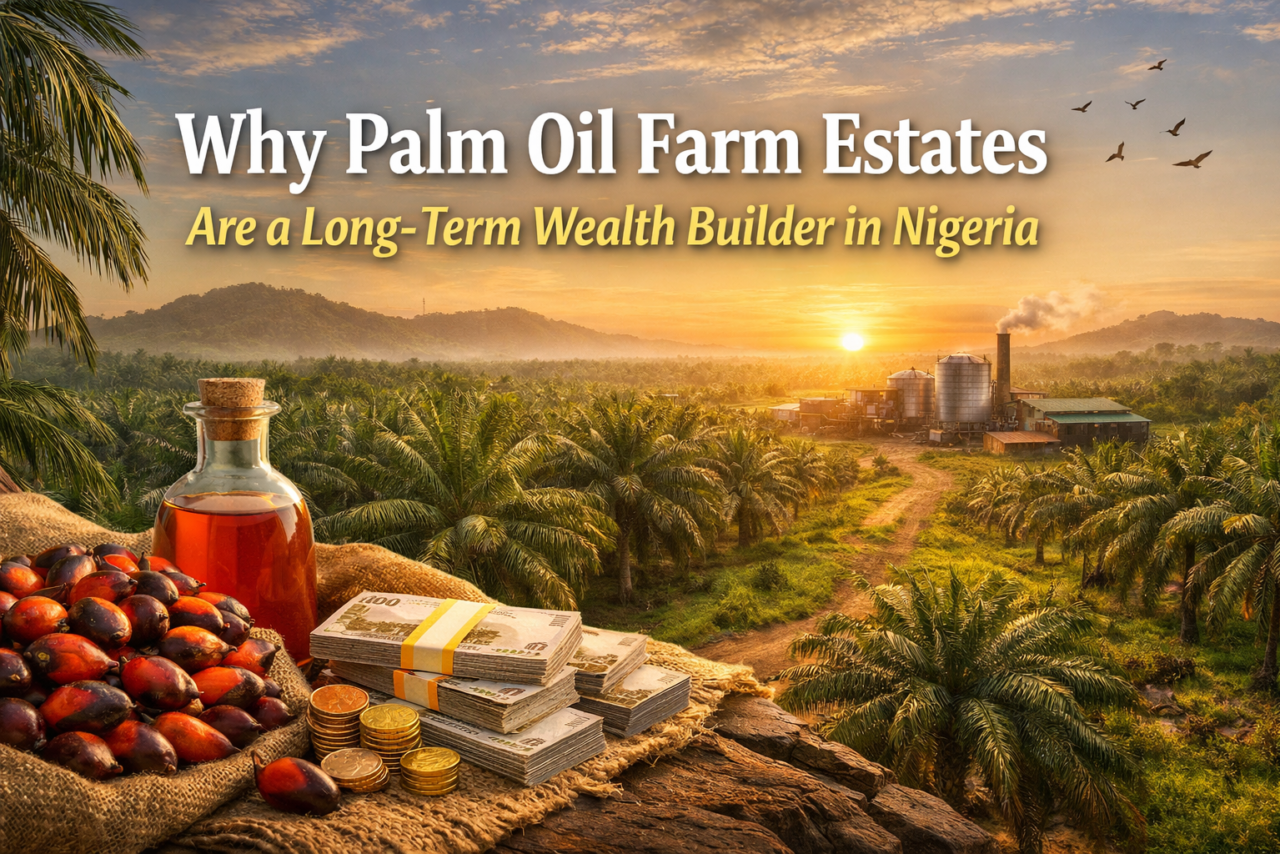

In a country where inflation keeps rising, the naira fluctuates, and traditional savings struggle to preserve value, smart investors are quietly positioning themselves in one sector that has built wealth for decades … palm oil.
Here’s a truth many seasoned investors understand: land can wait, but money cannot. Capital that sits idle loses value. But capital deployed into productive agricultural land, particularly palm oil estates, compounds steadily over time.
Palm oil farming may sound “old school,” but in reality, it is one of Nigeria’s most consistent and underestimated long-term wealth builders.
Understanding Palm Oil Farm Estates
A palm oil farm estate is not subsistence farming. It is a professionally managed agricultural investment model.
Investors purchase plots or hectares within a large-scale plantation operated by an experienced agricultural company. The company handles:
- Land clearing
- Planting of high-yield seedlings
- Agronomic management
- Harvesting
- Processing
- Sales and distribution
The investor earns annual profit share from harvests while the underlying land appreciates over time.
Oil palm trees typically:
- Begin meaningful production from Year 3–4
- Reach peak productivity between years 7 and 18.
- Continue producing fruit for 25–30 years
es to rise nationally, and agricultural investment is becoming more strategic. This is where Ogun State farm estates stand out.
They offer:
- Lower entry cost compared to city properties
- Flexible plot sizes
- Income-generating agricultural opportunities
- Strong long-term appreciation potential
- Strategic positioning near Lagos expansion
You’re not just buying land. You’re buying productive land.
Why Ogun State?
Ogun State sits at the edge of Lagos, Nigeria’s commercial powerhouse. As Lagos becomes saturated, development naturally expands outward. Ogun State is positioned as the release valve for:
- Residential expansion
- Industrial growth
- Agricultural investment
- Infrastructure development
This makes it a one time structured investment with decades of potential returns.
Why Palm Oil Remains a Strategic Sector in Nigeria
Nigeria is one of the largest consumers of palm oil in Africa. Palm oil is essential for:
- Household cooking
- Noodles and processed foods
- Soap and cosmetics
- Industrial manufacturing
Current industry data indicates that Nigeria consumes over 3 million metric tons annually, yet local production falls significantly short of demand. The supply gap has led to consistent imports, costing the country hundreds of millions of dollars yearly.
This structural demand-supply imbalance creates:
- Strong local demand
- Price resilience over time
- Long-term growth opportunities for domestic producers
- Major agribusiness companies such as Okomu Oil Palm Company and Presco Plc continue expanding operations a strong indicator of sector confidence.
- Government policy has also increasingly supported backward integration and local agricultural production.
The Investment Case for Palm Oil Estates
1. Structural, Non Seasonal Demand
Palm oil is not a trend-driven commodity. It is a staple. As Nigeria’s population grows, consumption rises. Long-term demand fundamentals remain strong.
2. Long-Term Passive Income
Unlike speculative investments requiring constant monitoring, palm oil estates operate on biological growth cycles.
After the initial non-producing years, investors typically begin receiving:
- Annual harvest payouts
- Increasing yields as trees mature
- Price-adjusted returns tied to commodity value
In well-managed estates, annual returns after maturity are often projected between 20–40% of initial capital, depending on yield performance and market conditions.
3. Inflation Hedge Through Land Appreciation
Agricultural land historically appreciates in value, especially when:
- It is already planted and productive
- Infrastructure (roads, processing mills) exists
- Demand for farmland increases
Because both land value and palm oil prices tend to rise over time, investors benefit from dual growth:
1. Capital appreciation
2. Ongoing harvest income
3. This makes palm oil estates a practical hedge against inflation and currency volatility.
4. Accessible Entry Point
Contrary to popular belief, agricultural estate investments are no longer limited to ultra-high-net-worth individuals.
Many professionally managed estates offer:
- Half-hectare or one-hectare allocations
- Entry points between ₦2 million – ₦10 million (depending on location and development stage)
- Installment payment plans
- Buy-back options in some structures
- This accessibility has opened the market to:
- Salary earners
- Civil servants
- Retirees
- Entrepreneurs
- Even young professionals seeking long-term portfolio diversification
- High-Growth Locations for Palm Oil Estates
Certain regions have demonstrated strong performance due to favorable soil, rainfall patterns, and infrastructure access. These include:
- Edo State (Ekehuan, Okomu axis)
- Ondo State
- Cross River State
- Parts of Ogun State with suitable soil conditions
Proper due diligence is essential to ensure the land is:
- Not flood-prone
- Legally documented
- Professionally managed
Why Timing Matters
As awareness grows, institutional and urban investors are increasingly entering the agricultural estate space. Historically, early participants benefit most from:
- Lower entry pricing
- Faster capital appreciation
- Compounding harvest returns over longer periods
In long-cycle investments like oil palm, time in the market is more powerful than timing the market.
Risk Considerations
Like all investments, palm oil estates carry risks, including:
- Agricultural yield variability
- Commodity price fluctuations
- Management quality dependence
- Long gestation period before harvest
Investors should evaluate:
- The track record of the management company
- Land documentation and title
- Processing infrastructure
- Transparent profit-sharing structure
- Professional oversight and clear contractual agreements are critical.
- Final Thoughts: Wealth Built Quietly
While many chase short-term returns in volatile markets, long-term wealth in Nigeria has often been built through:
- Land
- Agriculture
- Patient capital
Palm oil farm estates combine all three.
They offer:
- Tangible asset ownership
- Exposure to a high-demand commodity
- Multi-decade production cycles
- Passive income potential
- Capital appreciation
For investors seeking stability, generational assets, and inflation protection, palm oil estates represent a compelling long-term strategy.
Considering Palm Oil as Part of Your Portfolio?
Before investing, consult with a financial advisor, conduct thorough due diligence, and ensure the estate aligns with your long-term financial goals.
Wealth is rarely built loudly. Sometimes, it grows quietly, tree by tree, season after season.


Leave a Reply