

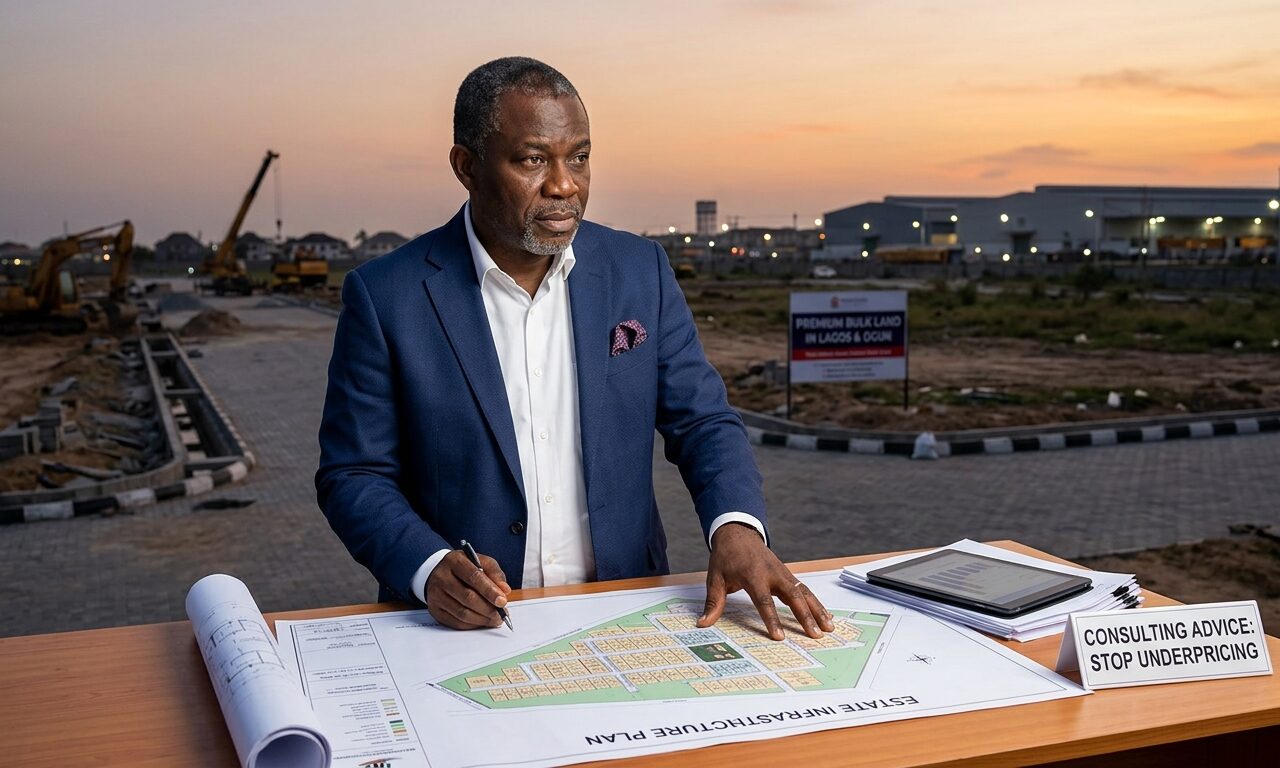

“Let me state this publicly!
As a real estate and investment expert with over 12 years of experience in Nigeria and internationally, I’m offering developers $10,000 worth of consulting advice for free. If you own bulk land in Lagos, Ogun State, or Abuja, in a developed area with major infrastructure or industries just 5 to 10 minutes away, and you are still selling plots for less than ₦5 million to ₦10 million, you may be setting yourself up for serious trouble in the future.”
Your land may be valuable, but if you fail to understand the full cost of developing it, your investment could become a financial burden.
If your land is located in a developed area with major infrastructure, industries, and commercial activities within five to ten minutes, you need to evaluate your pricing strategy carefully. Selling plots for less than ₦5 million to ₦10 million without properly assessing your costs and the local market could undermine the financial viability of your project.
Beyond pricing, developers must account for land documentation, statutory approvals, estate layouts, surveys, soil testing, fencing, gatehouses, roads, drainage, and other essential infrastructure.
Depending on the location and project requirements, these expenses can run into hundreds of millions or even billions of naira.
For example, developing a 20-acre estate in Ogun State could involve more than ₦500 million in documentation-related expenses and over ₦700 million for minimum-standard infrastructure, based on the illustrative estimates I have highlighted. These figures are not fixed industry rates; every project requires a professional cost assessment.
The challenge is that many developers calculate the potential revenue from selling plots without accurately determining the total cost of delivering the estate. This is how projects become financially strained, leaving developers struggling to complete infrastructure, satisfy clients, or meet their obligations.
Success with one project does not automatically mean you understand every aspect of real estate development. Market conditions change, costs rise, and larger projects demand stronger financial planning, professional expertise, and sound business structures.
The era of selling land without adequately budgeting for documentation, approvals, and infrastructure must come to an end.
My advice to developers is simple: conduct proper feasibility studies, verify your legal and regulatory requirements, understand your market, and establish a realistic budget before committing your capital.
I share this knowledge because I believe that the right information can help developers avoid costly mistakes and build sustainable businesses.
Learn. Relearn. Unlearn.
In real estate development, proper planning is not an option. It is the foundation of a successful investment.



Leave a Reply